Little Dances:
Meiosis in a Metaphor
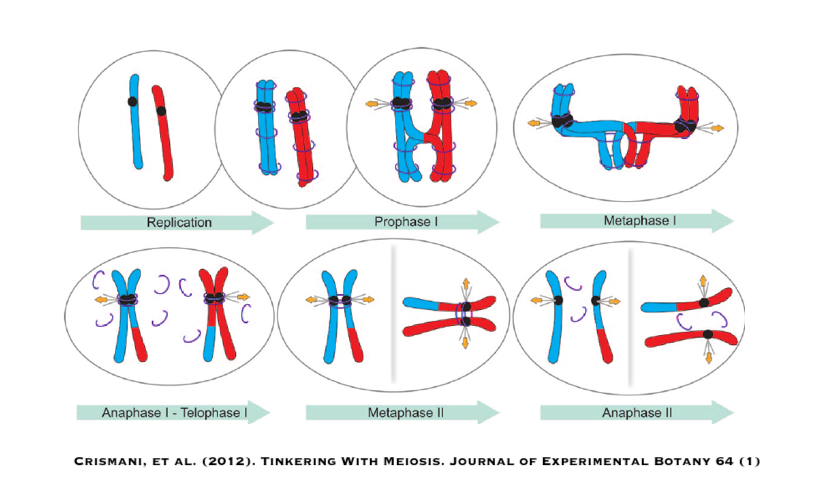
Meiosis is the cellular process in which tomato chromosomes (each tomato has two sets of chromosomes) replicate and swap segments, creating a new set of single chromosomes that has some traits from each parent and is ready to combine with another single set to make a fully functioning pair within a seed, that can go on to become a new plant.
Tomatoes are “dancing” and swapping “skills”
You can visualize each pair of chromosomes as a dancing couple that each have skills/traits (“functional abilities”) in a series of skill/trait slots (alleles of a gene at a particular locus).
When they dance, they really dance, swapping skills/traits into each other’s skill/trait slots as they make a new set of singles (pollen in the anther cone and ovules in the ovary) that go on to meet up with another set of singles to make another dancing couple with skills/traits (a new tomato plant).
Here’s an example:
One parent has the skill/trait to make red fruit and regular leaves (Dominant traits), and the other has the skill to make yellow fruit and potato leaves (these are both recessive traits, “skills that take two slots” one from each set of chromosomes.)
The hybrid F1 will have one copy of the Dominant (R) Red fruit skill/trait and one copy of the recessive (r) yellow fruit skill/trait; notated as heterozygous Rr and it will have one copy of the Dominant (C) regular leaf skill/trait and one copy of the recessive (c) compound/”potato leaf” skill/trait; notated as heterozygous Cc.
Therefore it will have red fruit and regular leaves; it has one copy of the Dominant skill/trait that makes each and that is enough.
Recessive genes, “skills that take two slots” one from each set of chromosomes are that way because they are a “loss of function” skill.
For example, rr lost the function to create phytoene synthase (PSY1) the precursor to all carotenoid development, and therfore will be yellow. This is a loss to flavor too, as much of the flavor comes from carotenoids, so yellow tomatoes are generally… less flavorful.
But sometimes “loss is gain” — tt lost the function to create lycopene, the T gene codes for CRTISO which converts prolycopene (tetra-cis-lycopene) into lycopene, if there is one copy of T it will be able to make lycopene, but with two copies of t (and none of T) it has lost that function. The orange prolycopene is actually more absorbable by the body and so “tangerine gene” (tt) tomatoes are an interesting project to pursue.
And potato leaf is another “loss of function” skill/trait, that actually lends more disease resistance to the leaves, and more surface area of leaf to fruit in the plant overall, which is correlated to more flavor and higher sugar levels in the fruit. So potato-leaf is a skill/trait that is advantageous to maintain.
Another loss of function is greenstripe (gs), in which some of the pigment molecules in the epidermis (skin) undergo methylation that changes their color, the genesis of the methylation is such that it engenders a particular pattern of lighter and darker areas that appear as stripes.
Tomatoes are perfectly capable of “Dancing with Themselves”
Tomatoes have “perfect” flowers containing female and male parts, and they are capable of self-pollinating and usually do more than 95% of the time. Pollen is released onto the stigma (the pollen-receiving part that directs pollen down to the ovary) before the flower even opens (see “Timing is Everything: Making a Cross-Pollination”).
For a stable variety, each of its matching two chromosomes in the set of 12 will be like a mirror-image, it will have all the same skills in all the same skill slots. So when it creates each pollen and ovule by dancing, even though it is swapping skills in the slots, there are the same skills, so the result is that it does what it knows how to do, and creates the same plant with the same fruit.
Mutations do occur, and new skills can arise, some that are desired and some that are not. (Livingston looked for especially smooth and round mutations, heirloom seed saving selects for subtle mutations of improved flavor and vigor over time).
But for the most part, new combinations of skills are introduced by crossing two different varieties.
For each skill slot, there is a 50% chance that it will be filled by the Parent A allele (version of a skill) and 50% chance that it will be filled by the parent B allele.