“Landmark Tomatoes” and their lineages
In my eyes, these mark certain characteristics that are particularly interesting. I’m sure everyone has a different set of landmark tomatoes, these are mine. Both the landmark tomatoes and their descendants represent only a slice in the world of tomatoes, a peek in the door. An exhaustive tree and history are beyond this scope. This is my attempt to bring some context, mostly for my own mind, to the way that so many varieties are related, and to highlight some of the massive amount of work that these pioneering breeders put in to create these varieties and make them available.
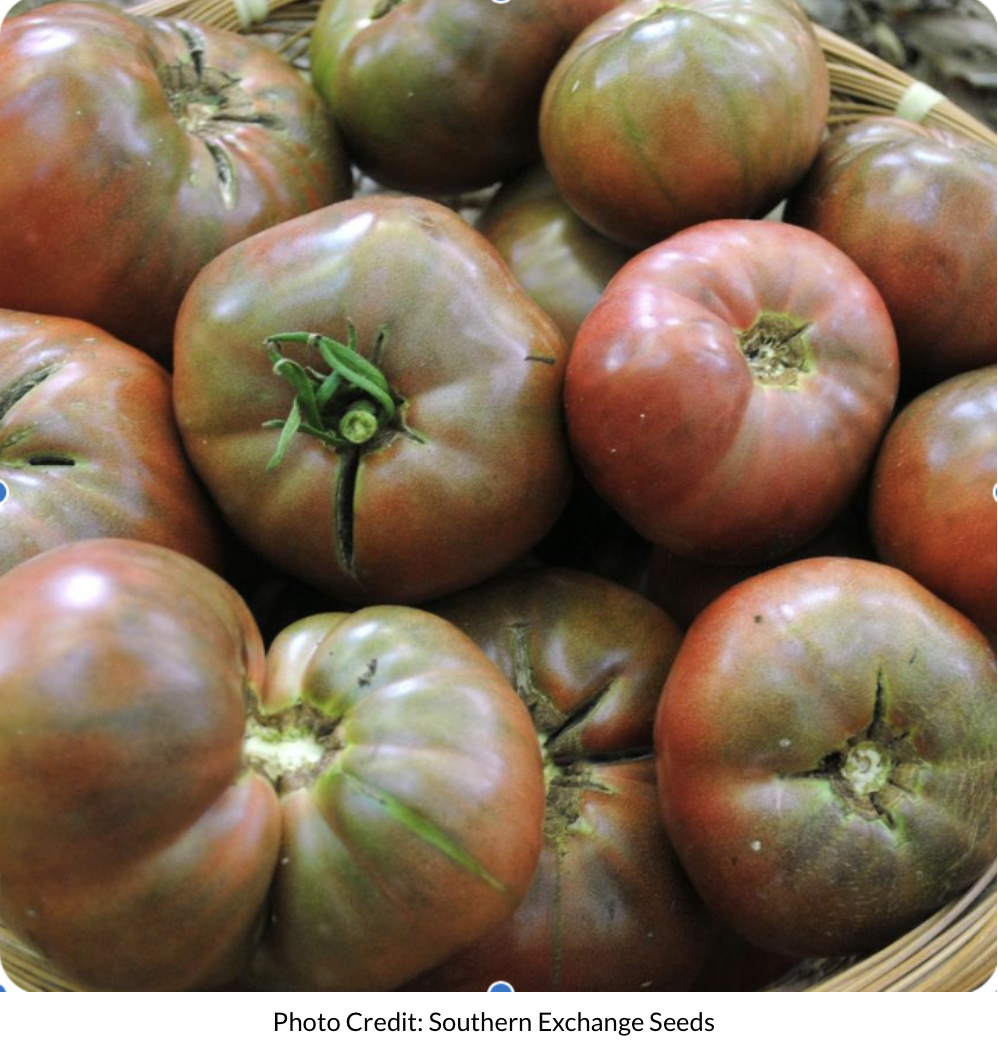
Cherokee Purple
(saved pre 1890s, brought to public by Craig LeHoullier in 1993)
Descendant varieties:
((Brandywine x Cherokee Purple F4) x Black Cherry)—> Purple Haze F1 (Keith Mueller 2006)
dehybridized/stabilized—> Kiss the Sky (Tatiana Kouchnareva 2013)
Cherokee Purple x unknown variety (presumably a tangerine orange paste tomato) —> Orange Caprese (Fred Hempel 2015)
Cherokee Purple x Green Zebra —> Berkeley Tie-Dye (Brad Gates 2007)
Berkeley Tie-Dye x Purple Haze F1 (plus mystery Beta orange?)—> Apricot Zebra (Mark McCaslin 2018)
Big White Zebra (mid 2010s) x Cherokee Purple —> Love Potion (Natali Cassanelli, Ukraine 2024)
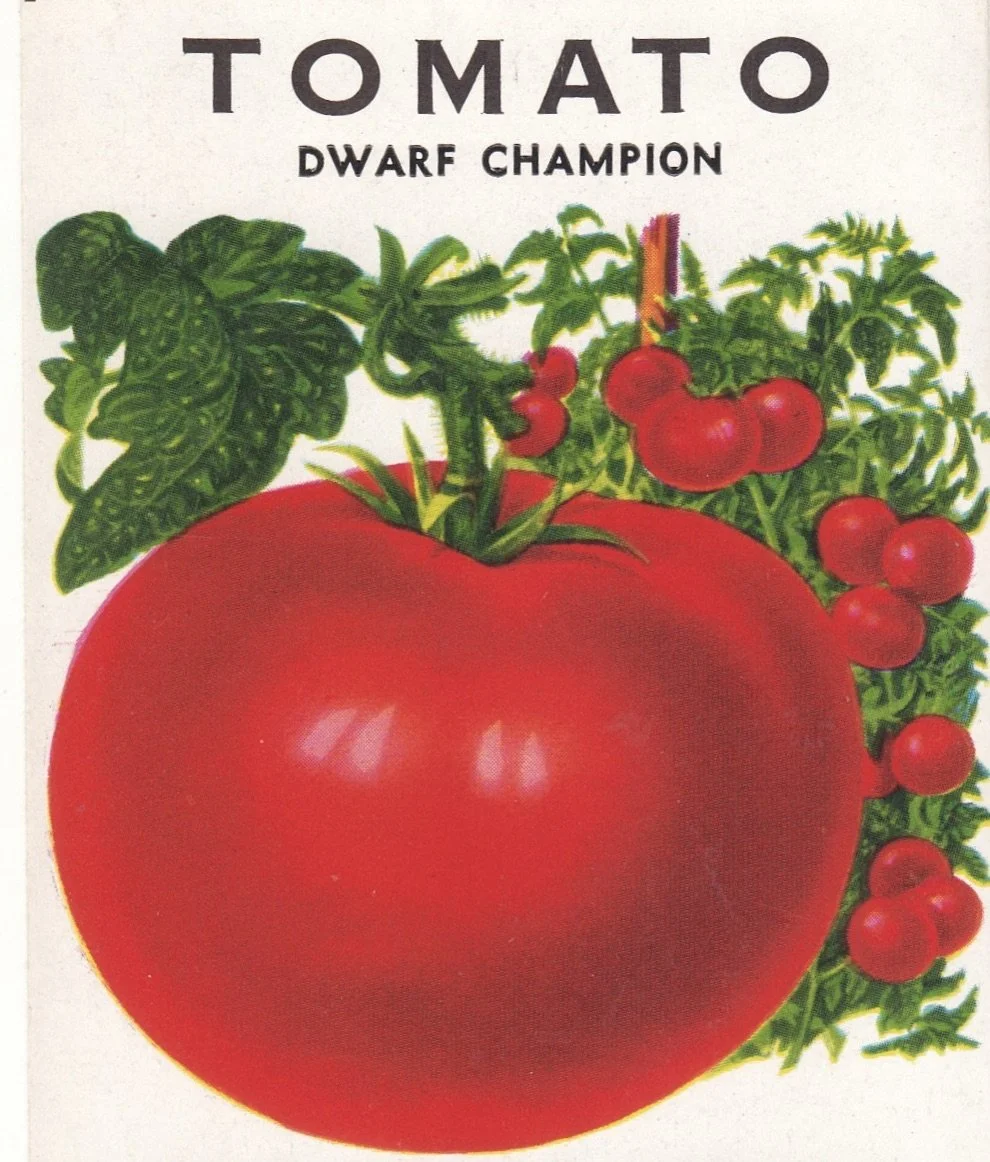
Dwarf Champion
A cross of the popular at that time Tomato de Laye (Originated around 1862 in a garden at the Château de Laye in France and commercialized in France by seed companies like Vilmorin-Andrieux in early 1860s) and an unknown variety (NOT Livingston’s Acme according to genetics analysis). Found in a field of Livingston’s Acme in 1886 by an unnamed farm worker and then developed and released by Maule in 1889. The plants are compact, and have rugose leaves (distinctively wrinkled/bumpy) and grow in a “tree” form that is almost able to support itself. It is a different gene from the “self-pruning” gene that makes varieties determinate, so it continues to produce throughout the season as an indeterminate, just more compact.
Descendant varieties:
Dwarf Champion (Maule 1889) x Livingston’s Stone (Livingston 1889) —> Dwarf Stone (Livingston’s Sons 1902)
Dwarf Stone is the grandfather of the American dwarf lines used in the Dwarf Tomato project (Craig LeHoullier/Patrina Nuske Small), the inclusion of European lines like Budai Törpe means that not 100% of them are descendants of Dwarf Stone, but a majority of them are descendants.
Image on old seed packet
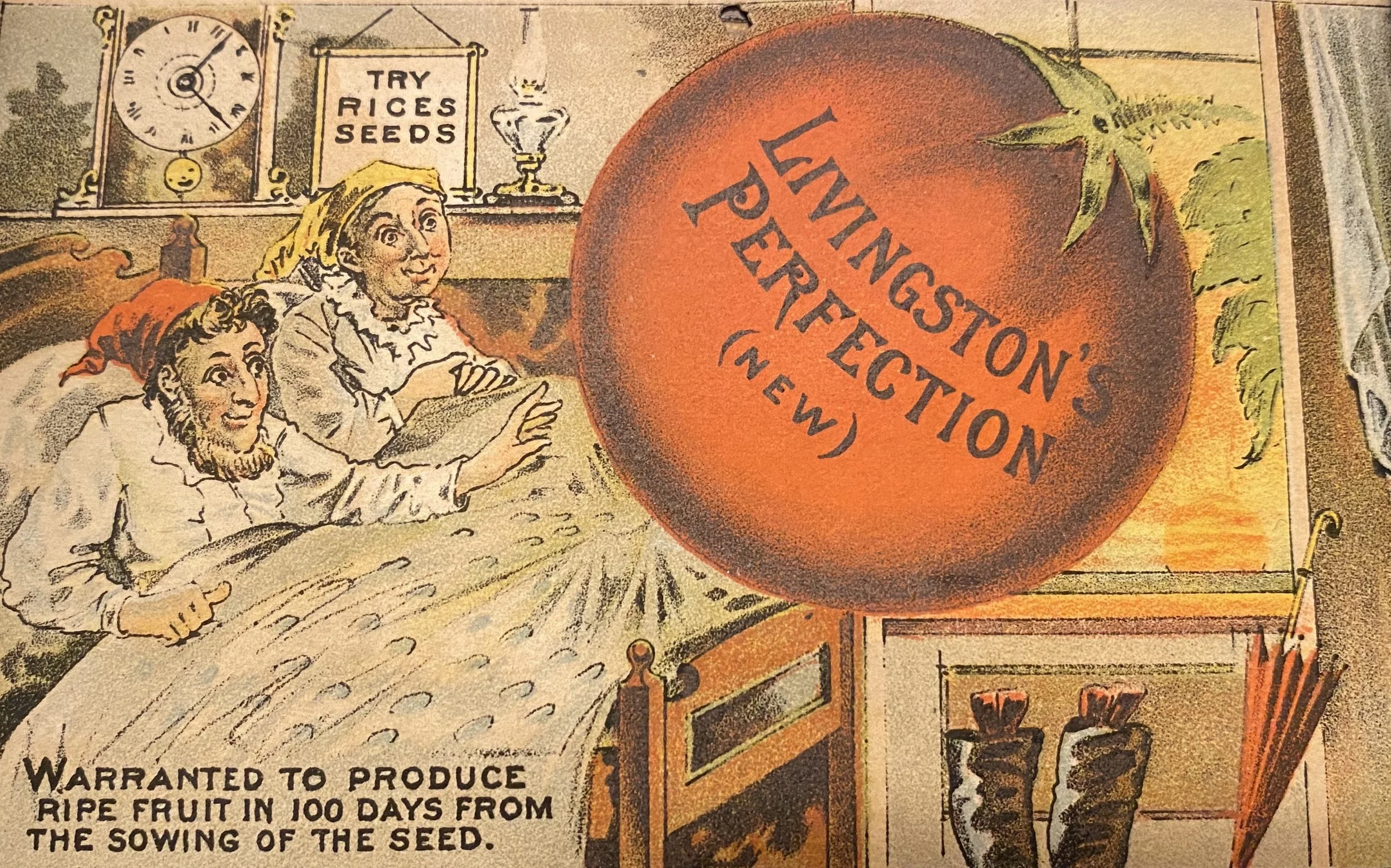
Livingston’s Paragon
A. W. Livingston (1821 - 1898) began with a field of tomatoes from a variety he had saved seeds from, and intensively selected for traits such as roundness and meatiness. His selections resulted in the development and release of Paragon in 1870— the world’s first perfectly smooth, uniform commercial red tomato— and many descendant varieties by him and then others.
Descendant varieties:
a distinct pink/purple selection from a field of Paragon —> Livingston’s Acme (Livingston 1875)
deeper red, heavier-cropping selection isolated out of Acme fields —>Livingston’s Perfection (Livingston 1880)
bred specifically as a further improvement on Perfection's size and processing qualities —> Livingston’s Favorite (Livingston 1883)
selected for firmness and longer keeping, mainstay for global canning. —> Livingston’s Stone (Livingston 1889)
Livingston’s Stone (1889) x Ponderosa (Peter Henderson 1891) —> Livingston’s Globe (Livingston’s Sons 1897) (—> Marglobe 1917—> Rutgers 1934)
Dwarf Champion (Maule 1889) x Livingston’s Stone (Livingston 1889) —> Dwarf Stone (Livingston’s Sons 1902)
Livingston’s Stone (1889) —> Greater Baltimore (John Baer 1905)
Image on old postcard of related variety
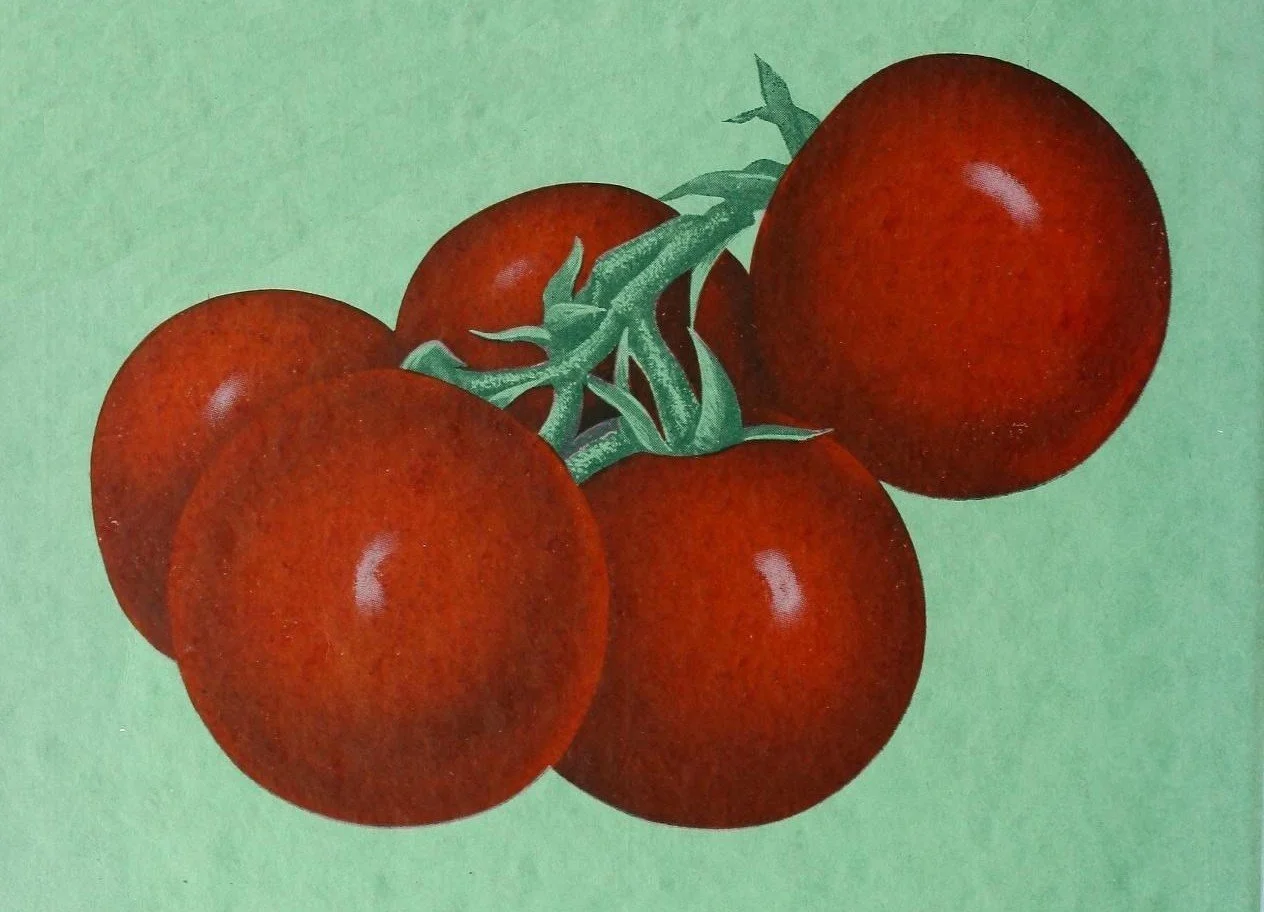
Marglobe
Developed in 1917 by USDA breeder Fred J. Pritchard by crossing Marvel (a disease resistant French heirloom) and 'Globe' (aka Livingston’s Globe; originally developed by A.W. Livingston in 1899/ released 1905, known for round shape, smooth skin, firm walls, and excellent slicing flavor, but it was highly susceptible to disease).
Marglobe is credited with saving the Florida tomato industry in the early 20th century, and it is a parent of Rutgers tomato, another titan of a tomato. At one point 70% of the tomato crop planted in US were Rutgers. As thicker-walled, thicker-juiced processor tomatoes were developed that were easier to mechanically harvest and process, those became the new standard in the 20th century, and continue today.
Descendant varieties:
from a pink mutant "sport" growing on a regular red Marglobe —> Marhio (Ohio Ag. Experiment Station 1932)
Marglobe x J.T.D. (breeding line developed by Campbell's Soup 1918) —> Rutgers (L.G. Schermerhorn at Rutgers University 1934)
Rutgers (1934) x Tangerine (Burpee 1937) —> Jubilee (Burpee 1943)
Pan American (1941; cross of Marglobe with Solanum pimpinellifolium for Fusarium race 1 res., Porte Beltsville) x Jubilee (1943) —> Sunray aka Golden Sunray ( Dr. W. S. Porte at the USDA Beltsville station 1950)
Jubilee x Florida mutant—> UF-D78044 (University of Florida line) x NCSU Resistant Breeding Lines (Piedmont / NC 8288) —> Mountain Gold aka NC 84173 (Dr. Randolph Gardner NCU Mountain Horticultural Crops Research Station 1990)
Marglobe image on 1930s seed packet
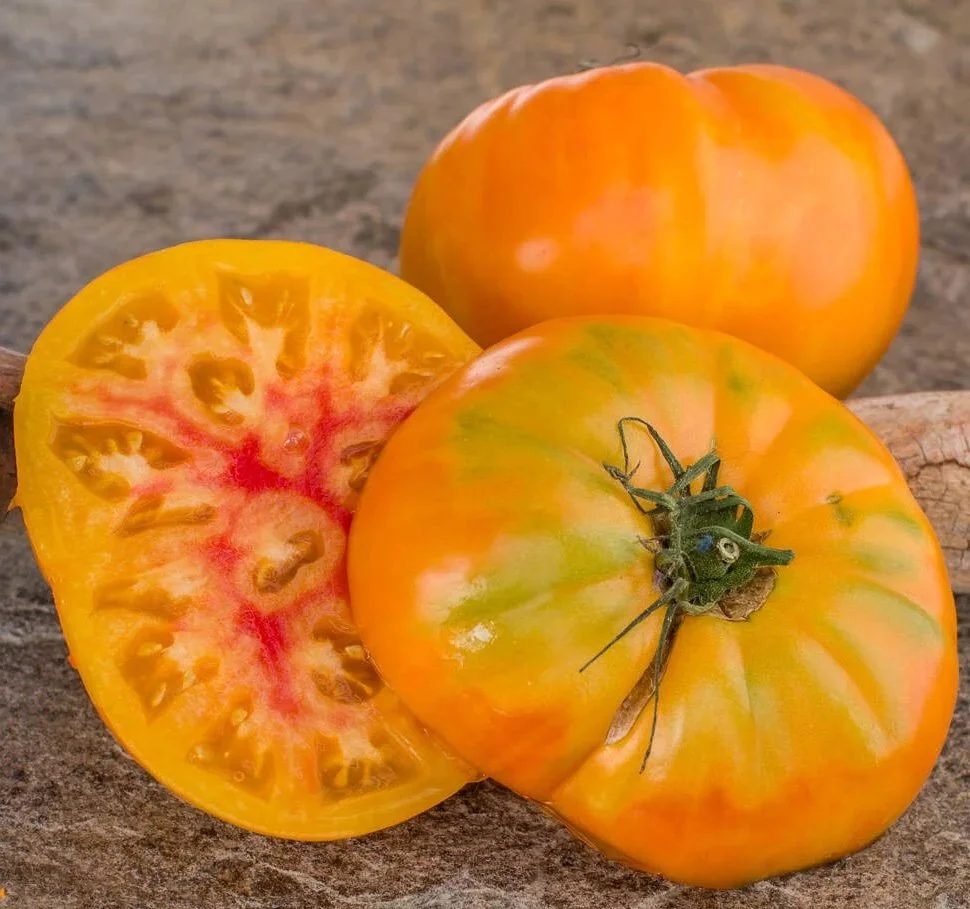
Lucky Cross (and Little Lucky)
(Craig LeHoullier 1993/2002)( Brandywine x (Tigerella x Old German F1))
Descendant varieties:
Lucky Cross (1993) x unknown —> Captain Lucky (Millard Murdock 2011)
Ludmilla Pink Heart (old Kazakhstan heirloom given by a Ludmilla to Reinhard Kraft who named the tomato in her honor, made available to public 2009) x Captain Lucky → True North Series: Taiga, Tundra, Midnight Sun, True Colors, Polaris (Karen Olivier, Canada 2019)
Ambrosia Gold Cherry (cross of Sungold F1 x Solanum pimpinellifolium; Lee Goodwin 2012) x Captain Lucky —> Karma Series: Karma Karma Pink, Karma Purple, Karma Purple Multiflora, Karma Miracle, Karma Peach, Karma Apricot (Karen Olivier, Marsha Eisenberg, 2019/2020)
Photo credit: Tom@TomatoFiFou
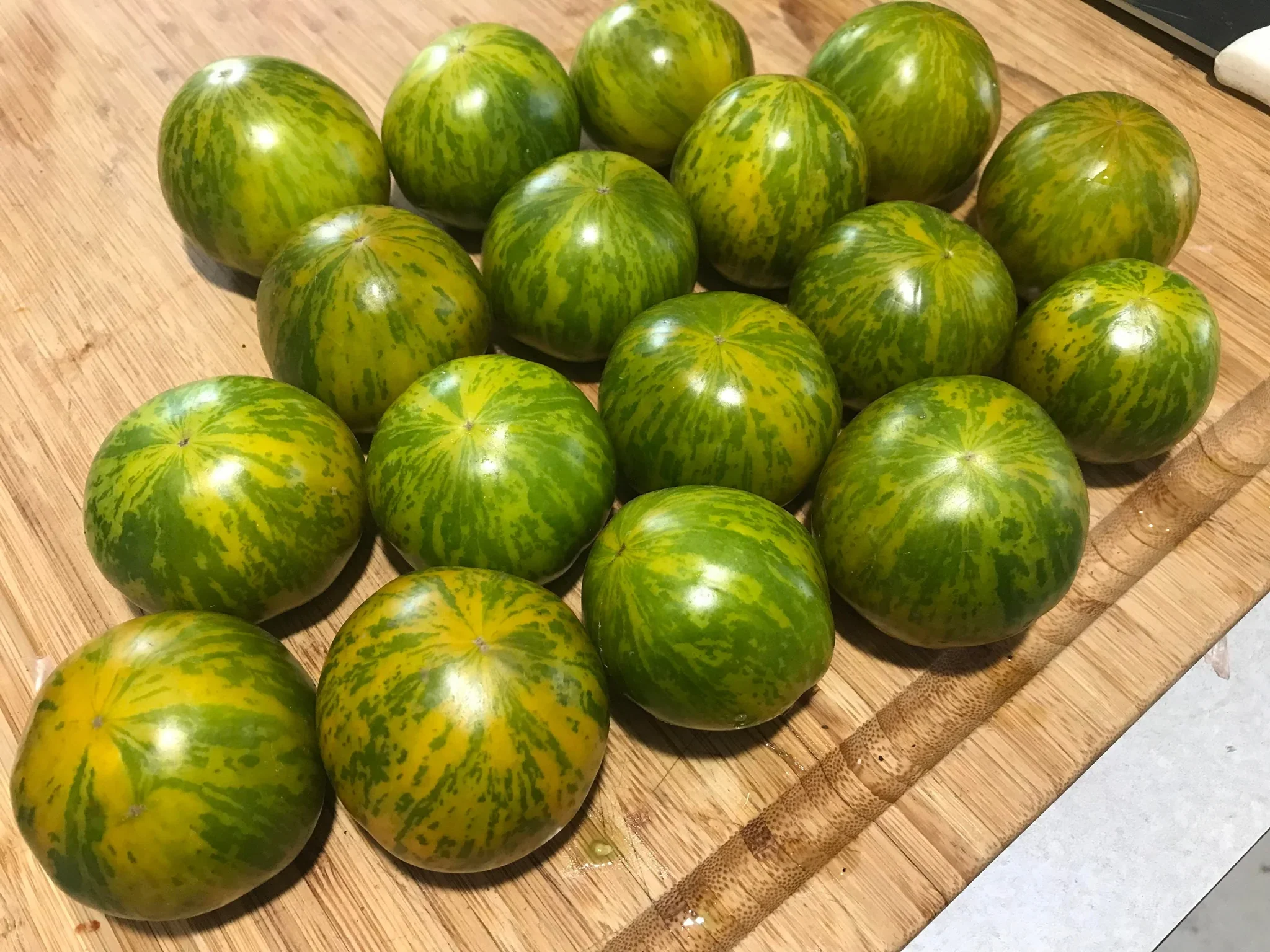
Green Zebra
(Tom Wagner 1983)
Descendant varieties:
Green Zebra x Cherokee Purple created Berkeley Tie-Dye (Brad Gates 2000s?)
Berkeley Tie-Dye x Purple Haze F1 (plus mystery Beta orange?)—> Apricot Zebra (Mark McCaslin 2018)
— probably in the parentage of Banana Legs (Tom Wagner, Reusser, Swenson 1980s)
Antique Roman x Banana Legs —> Speckled Roman (John Swenson 1997)
Black Cherry x Speckled Roman —> Maglia Rosa (Fred Hempel 2008) —
Maglia Rosa x Zucchero (unreleased cherry, Fred Hempel)—> Blush aka Blush tiger (2011),Green Tiger (2013, Lucky Tiger (2013), Pink Tiger (2014) (Fred Hempel)
spontaneous genetic variation (a "sport") (unknown amateur CA breeder) —> White Zebra (aka Great White Zebra) (early 2000s); refined as Blonde Boar (Brad Gates 2010)
White Zebra (aka Great White Zebra) x Great White Beefsteak (random mutation from yellow oxhearts in 1987; Gleckler Seeds 1991) —> Big White Zebra (mid 2010s)
Photo credit: Experimental Farm Network
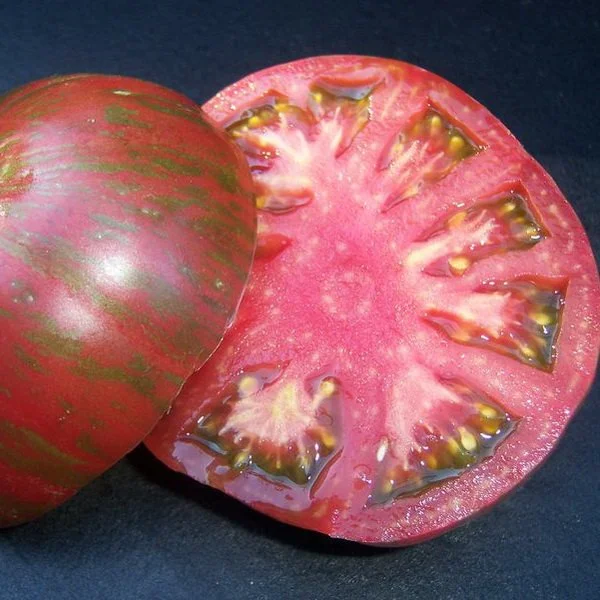
Berkeley Pink Tie-Dye
(Brad Gates 2008)
Created from a cross of Green Zebra (Tom Wagner 1983) x Cherokee Purple ->Berkeley Tie-Dye and then from a spontaneous mutation —> Berkeley Pink Tie-Dye
Photo credit: Wild Boar Farms
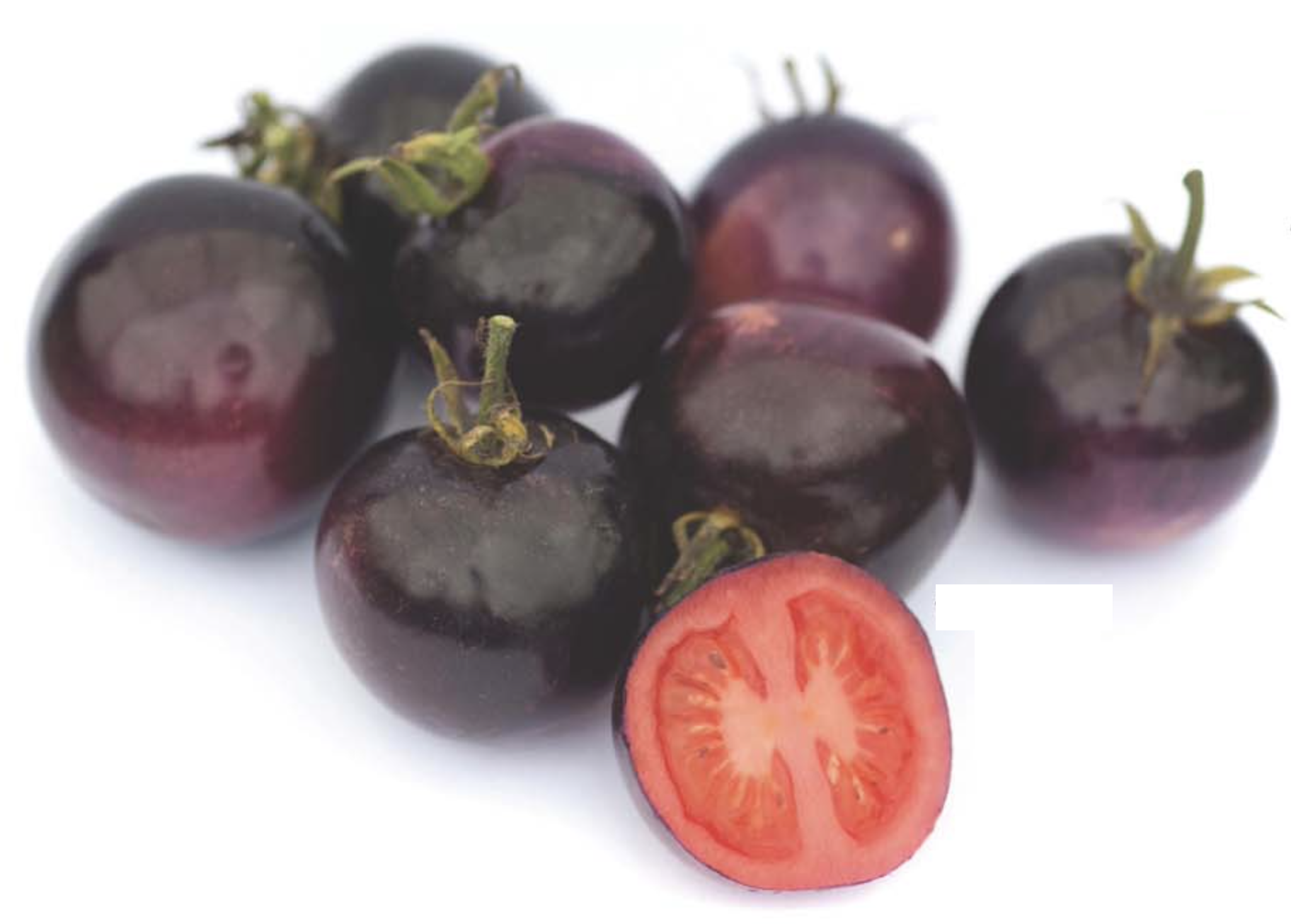
Indigo Rose
(Jim Myers OSU 2011)
The innovation was to combine the Aft (Anthocyanin fruit gene) from Solanum chilense and the atv (atroviolaceae gene) from Solanum cheesemaniae, into one plant using traditional breeding methods. The resulting increased anthocyanin in the epidermis of the fruit creates a purplish or “blue” color. There are many varieties derived from these, some including stripes like the next landmark tomato.
Descendant varieties:
OSU P20(related breeding line)/Indigo Rose x German Red Strawberry (old German heirloom, popularized by Dr. Carolyn Male 1993) —> Sergeant Pepper's (Jason Haynes 2015)
Pineapple Heart (unknown hobbyist breeder 2015; cross of Pineapple Giant (bicolor heirloom from Ohio, popularized by Merlin Gleckler of Gleckler's Seedmen 1950s) x Yellow Oxheart (old Eastern European heirloom, released as Livingston's Yellow Oxheart in 1929)) x Sergeant Pepper’s (Jason Haynes 2015) —> Amber Sergeant (Sofia Saakova 2023)
—> Indigo Apple (2014), Blue Beauty (Beauty King x Indigo Rose) (2014), Blue Gold (2014), Amethyst Jewel (2014), Lucid Gem (Blue Beauty x Beauty King) (2016), Black Beauty (Indigo Apple x Pink Berkeley Tie-Dye) (2016) (Brad Gates)
Indigo Rose (2011) x Oregon Star (cool climate paste developed by his OSU predecessor James Baggett, a cross between Santiam and Roma; 1993) —> Midnight Roma (Jim Myers OSU 2021)
Photo credit: Super Naturals Grafted Vegetables LLC
Rebel Starfighter Prime
(Russ Crowe 2018, from Xanadu Picasso x RHK GWR Heart)
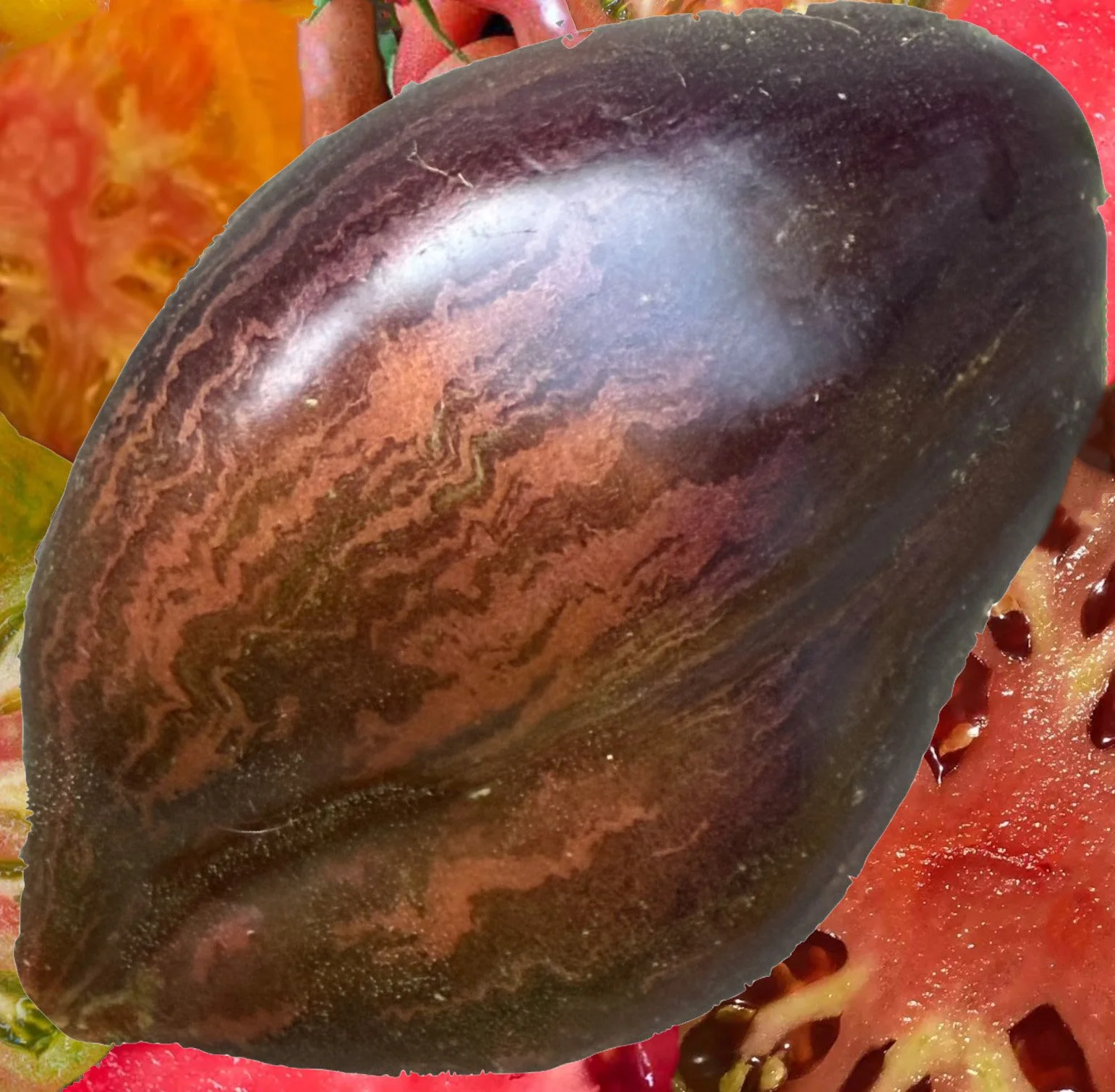
This tomato is derived from a cross between Xanadu Picasso, which has anthocyanin and stripes and Reinhard Kraft’s Green When Ripe heart. The leaves are wispy and people growing it for the first time may worry when comparing it to other plants that it is not thriving, but it will continue to grow in good conditions, however spindly it may look, and produce a bunch of these stellar tomatoes.
Descendant varieties:
Rebel Starfighter Prime x Dwarf King Aramis —> Rebel Starfighter Dipper's Delight (Russ Crowe 2023
Rebel Starfighter Prime x Snow White Cherry —> Rebel Starfighter Kayleigh Anne (Russ Crowe 2023)
Lunar Mile (unreleased Blane Horton variety ~2014) x Rebel Starfighter VT16 (sibling to RSP; Russ Crowe 2018) —> Rebel Starfighter Blane’s Moonlight (Russ Crowe, stabilized by Blane Horton; 2023)