Gene Map (Skill Slots)
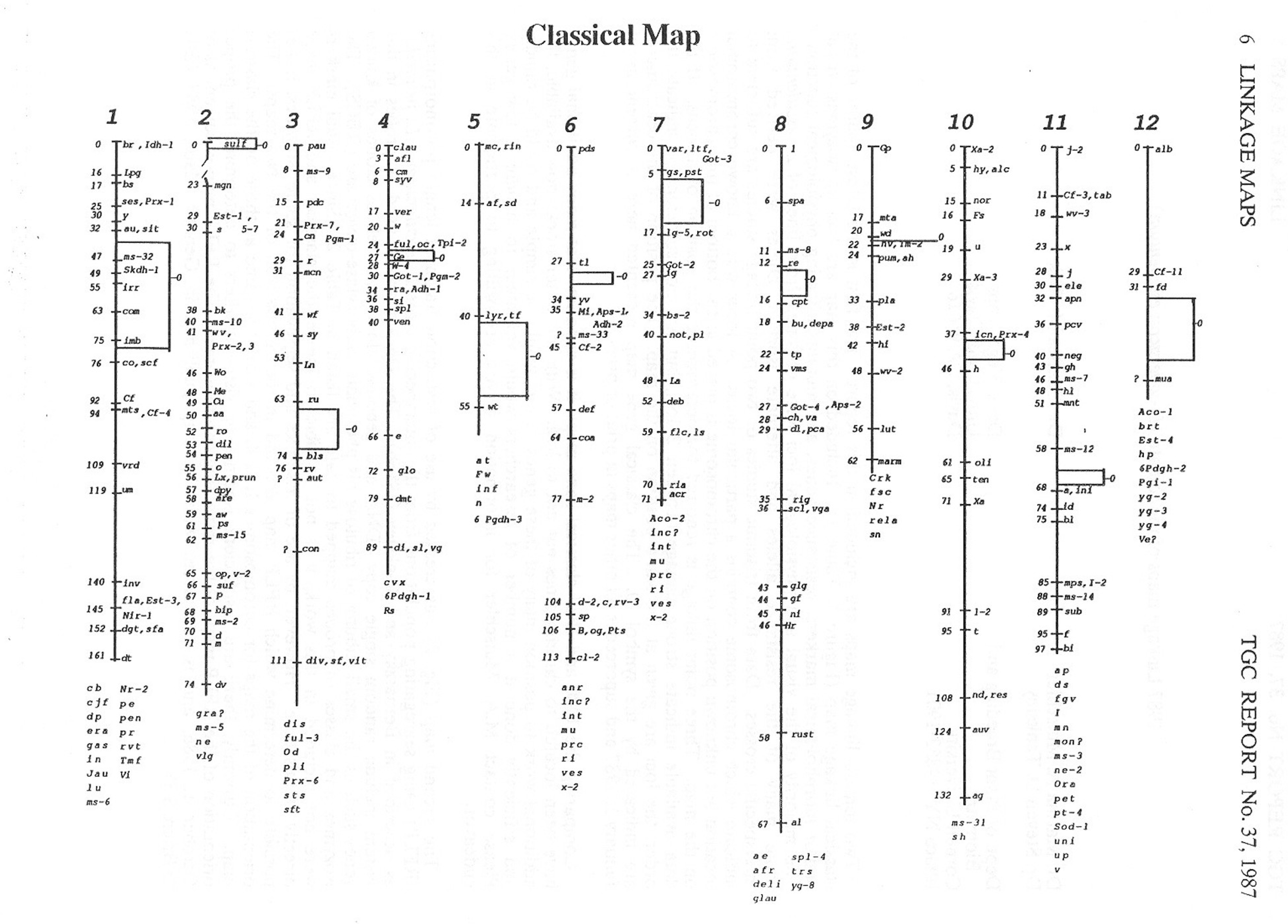
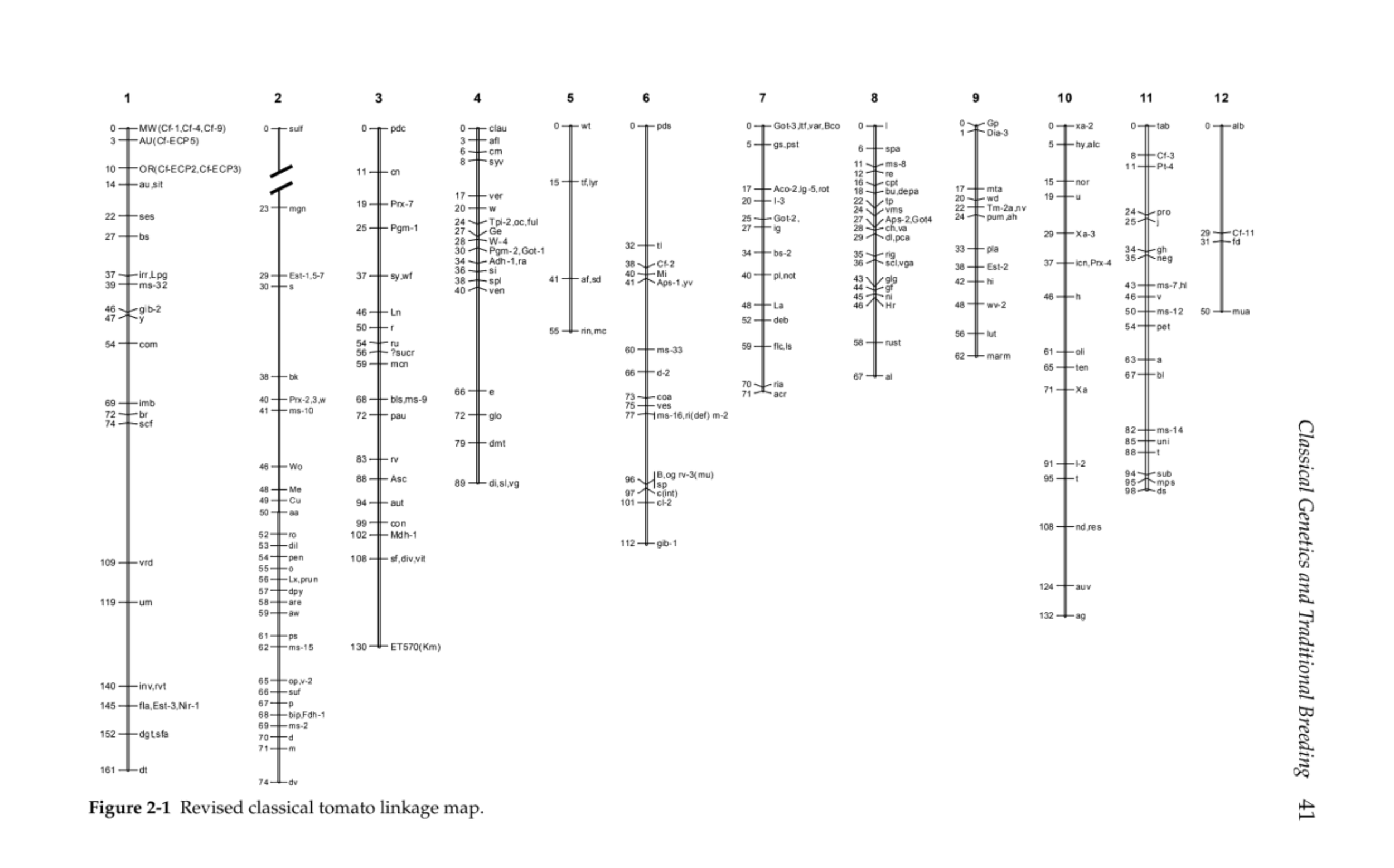
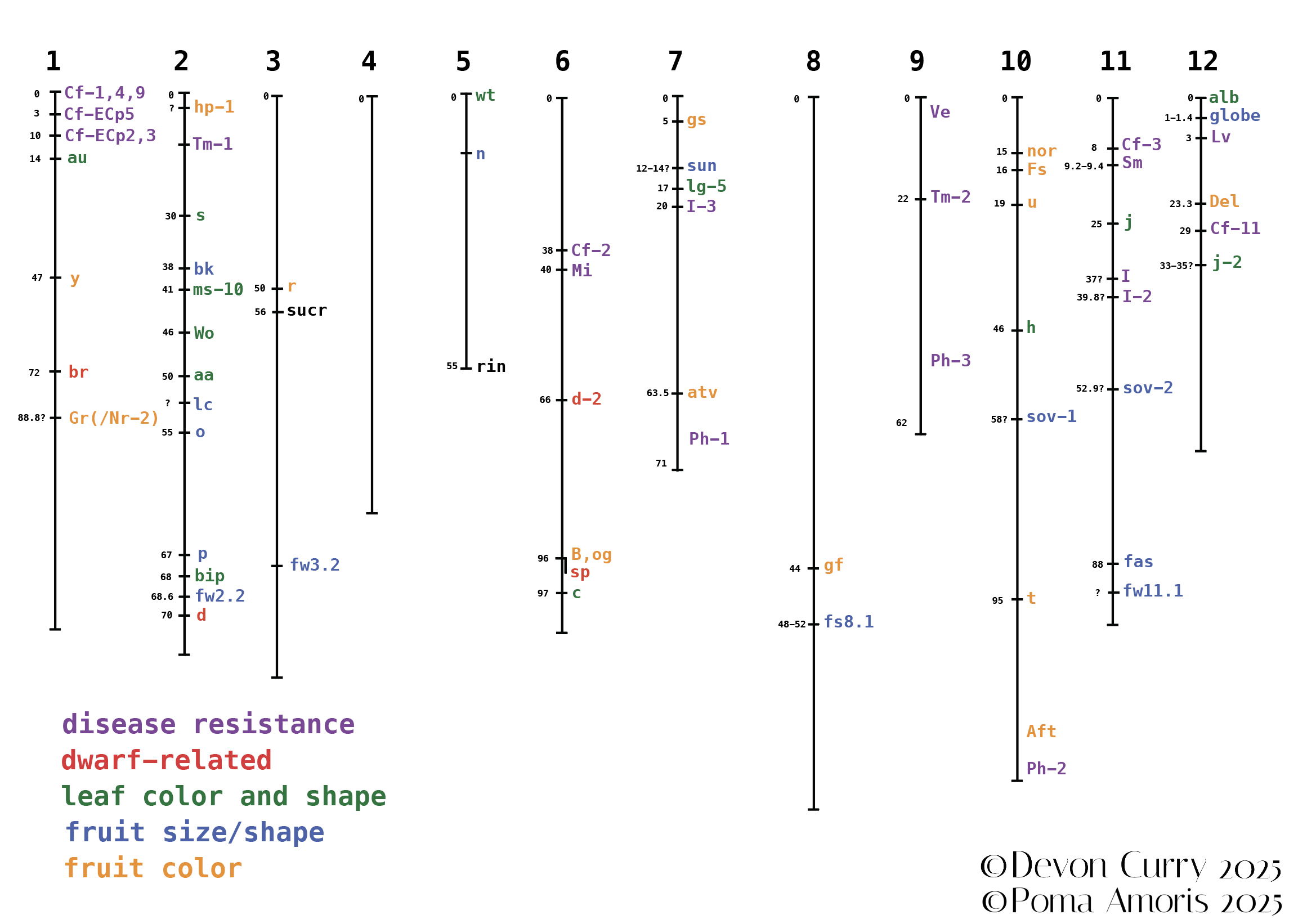
This is a map of where many genes are located on the tomato chromosome, the locus (physical location; “skill slot”) of each allele (version of a gene; “skill”). I use this map to keep track of the genes in various projects and update it as I learn more.
If you personify tomatoes, you can look at the way they reproduce (their chromosomes crossing over and replicating), as “dancing” and swapping “skills” (genes) as a poetic comparison for their behavior and this can be seen as a map of skill slots.
There are two ways to mark the location for a gene- in absolute terms where it is in millions of base pairs (Mb), or in relative terms how often it recombines separately from a nearby gene (in centimorgans cM; 50 cM being completely unlinked, less than that means it is loosely or tightly linked. For example, a distance of 8cM means that 8% of recombinations will have the genes be separate, or 92% of the time the genes will be swapped together. Nearby skill slots are more likely to be swapped together by the structure of the dance.
For each skill that is different between two halves of a dancing couple of chromosomes, there is a step that must be made, and it can go one way or another. To pay attention to which step is taken (to the extent that we can) is to watch the dance unfold, and to watch a new tomato variety be born. The more differences between the tomatoes, the more possible variants can emerge, the more chaotic the dance can be.
Choosing two similar tomatoes that have only a few genes different means that the dance will be very measured, and the pool of possibilities will be smaller. I prefer to take it one step at a time. Sometimes it’s reasonable to do 2 steps at a time (two differences between tomatoes); and look through about 20 tomatoes to find the ¼ x ¼ =1/16 chance of finding them (for recessive genes).
Trying to combine more steps than that is possible with another kind of technique; screening at the seedling stage (e.g. for potato leaf, or tangerine orange, or anthocyanin) can reduce the number of variables and the number of seedlings required to find what you are looking for.
A larger operation might be able to grow out hundreds or thousands of plants and look for varieties, I am working in the range of about 20 to 80 seedlings at a time.