Little Dances:
Mating, Match-making, Meiosis:
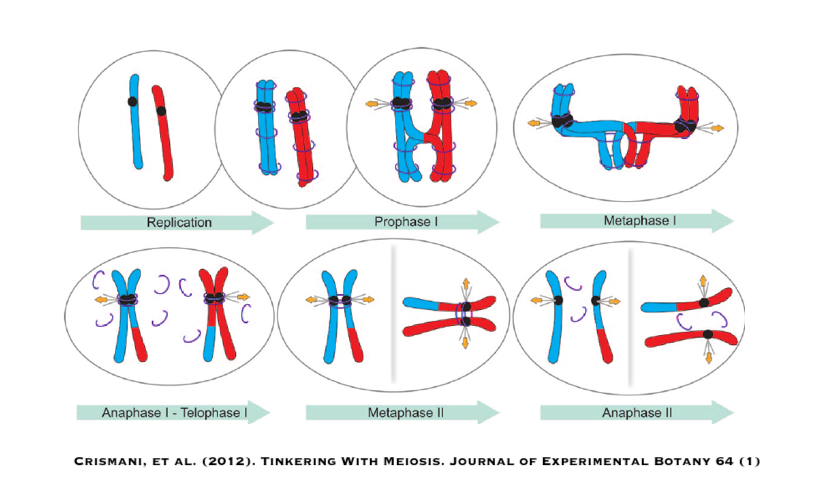
TOMATOES ARE “DANCING”
AND SWAPPING “SKILLS”
Within each tomato is a dancing couple (two sets of chromosomes)
that each have skills in a series of skill slots (alleles of a gene at a particular locus) “functional abilities”
And when they dance, they really dance, swapping skills into each other’s skill slots as they make a set of half-dancers (pollen in the anther cone and ovules in the ovary) that go on to meet up with another half-dancer to make another dancing couple with skills (a new tomato plant).
To illustrate now with an example:
One parent has the skill to make red fruit and regular leaves (Dominant traits), and the other has the skill to make yellow fruit and potato leaves (these are both recessive traits, “skills that take two slots” one from each set of chromosomes.)
The hybrid F1 will have Rc and Cc, therefore have red fruit and regular leaves; it has one copy of the skill that makes each and that is enough.
Recessive genes, “skills that take two slots” one from each set of chromosomes are this way because it is a “loss of function” skill
e.g tt lost the function to create lycopene, the T gene codes for CRTISO which converts prolycopene (tetra-cis-lycopene) into lycopene, if there is one copy of T it will be able to make lycopene, but with two copies of t (and none of T) it has lost that function. But sometimes “loss is gain” the orange prolycopene is actually more absorbable by the body and so “tangerine gene” (tt) tomatoes are an interesting project to pursue.
e.g. potato leaf
e.g. greenstripe
ETC
Tomatoes are perfectly capable of
DANCING WITH THEMSELVES
Tomatoes have “perfect” flowers containing female and male parts, and they are capable of self-pollinating and usually do more than 95% of the time. Pollen is released onto the stigma (the pollen-receiving part that directs pollen down to the ovary) before the flower even opens (see “Timing is Everything: Making a Cross-Pollination”).
For a stable variety, each of its matching two chromosomes in the set of 12 will be like a mirror-image, it will have all the same skills in all the same skill slots. So when it creates each pollen and ovule by dancing, even though it is swapping skills in the slots, there are the same skills, so the result is that it does what it knows how to do, and creates the same plant with the same fruit.
Mutations do occur, and new skills can arise, some that are desired and some that are not. (Livingston, heirloom seed saving)
But for the most part, new combinations of skills are introduced by crossing two different varieties.
For each skill slot, there is a 50% chance that it will be filled by the Parent A allele (version of a skill) and 50% chance that it will be filled by the parent B allele.
Selecting Dominant traits
e.g. my Pink Tiger x Rebel Starfighter Prime
all gs/gs, but Greenripe (Gr) and Anthocyanin fruit (Aft) are Dominant skills
Selecting recessive traits
e.g. Little Lucky x Beauty Queen
all bicolor, but potato leaf (c) and stripes (gs) are recessive
Left up to chance
If you aren’t selecting for it directly, it may be selected for indirectly (by choosing the best flavor and vigor) or it’s up to chance. For each skill slot, it’s a 50% chance (coin flip) whether it is filled by Parent A and B skill, once both skills are the same, there is no way there will be different down the line. so once a skill is gone, for better or worse, that skill is gone from the skill set, and can only be introduced by crossing with another variety that has that skill (gene).
“linkage” when skill slots are close together they are often swapped together, and that partly accounts for deviations from the coin flipping estimates. reason to use a gene map.