Choreography:
Following the footwork of Classical (Mendelian) Genetics
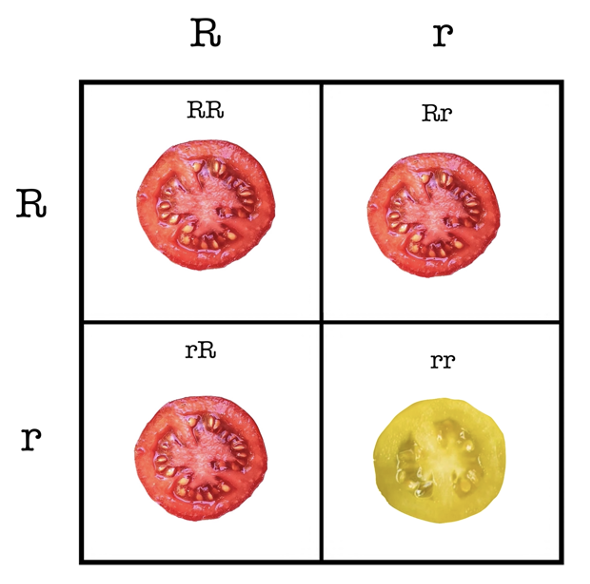
R (Red fruit) and r (yellow fruit); RR homozygous will be red, Rr and rR heterozygous will be red, rr will be yellow. About 1 in 4 will be yellow.
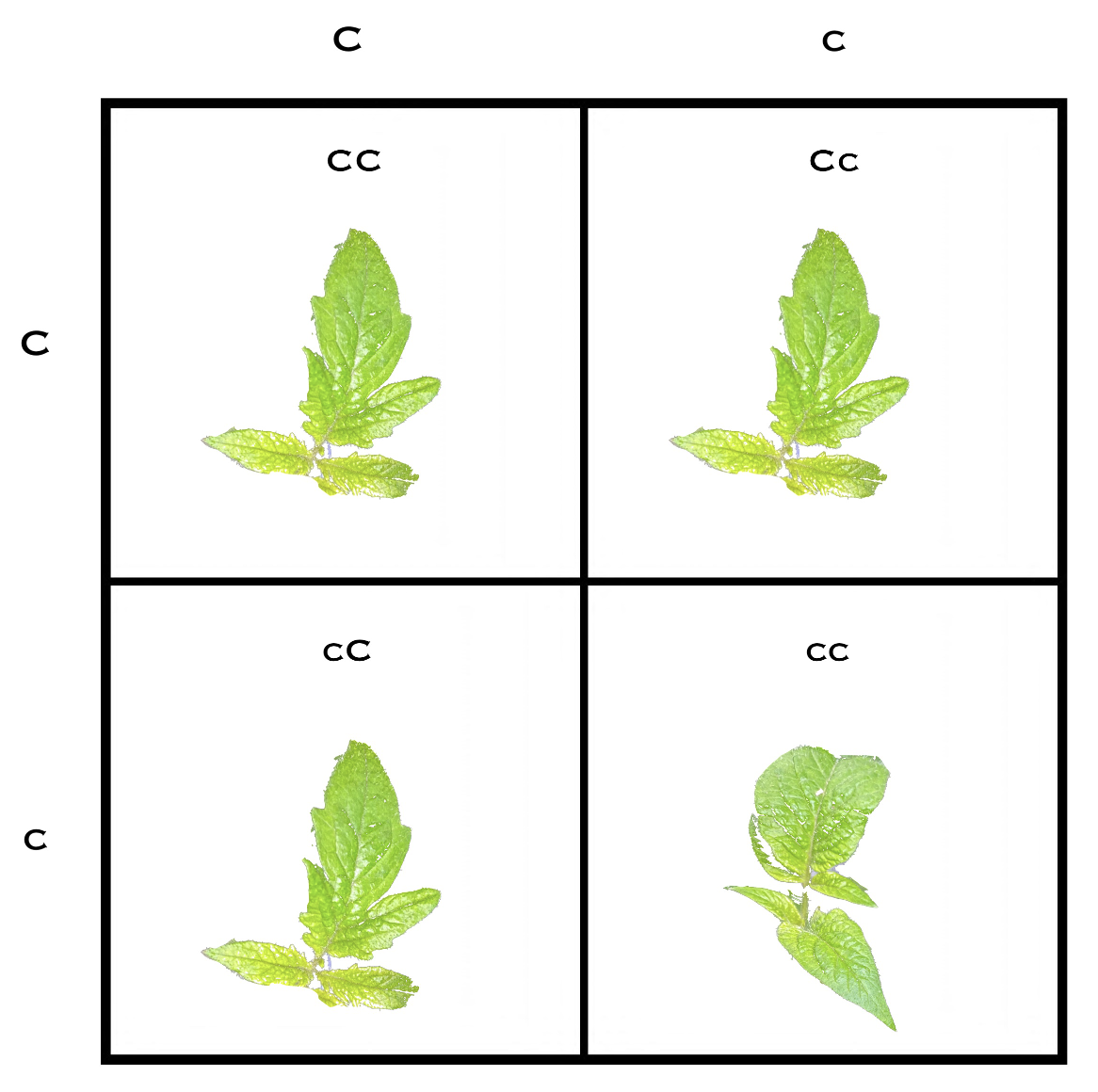
C (regular leaf) and c (compound leaf aka potato leaf). CC homozygous will be regular leaf, Cc and cC heterozygous will be regular leaf, cc homozygous will be potato leaf. About 1 in 4 will be potato leaf.
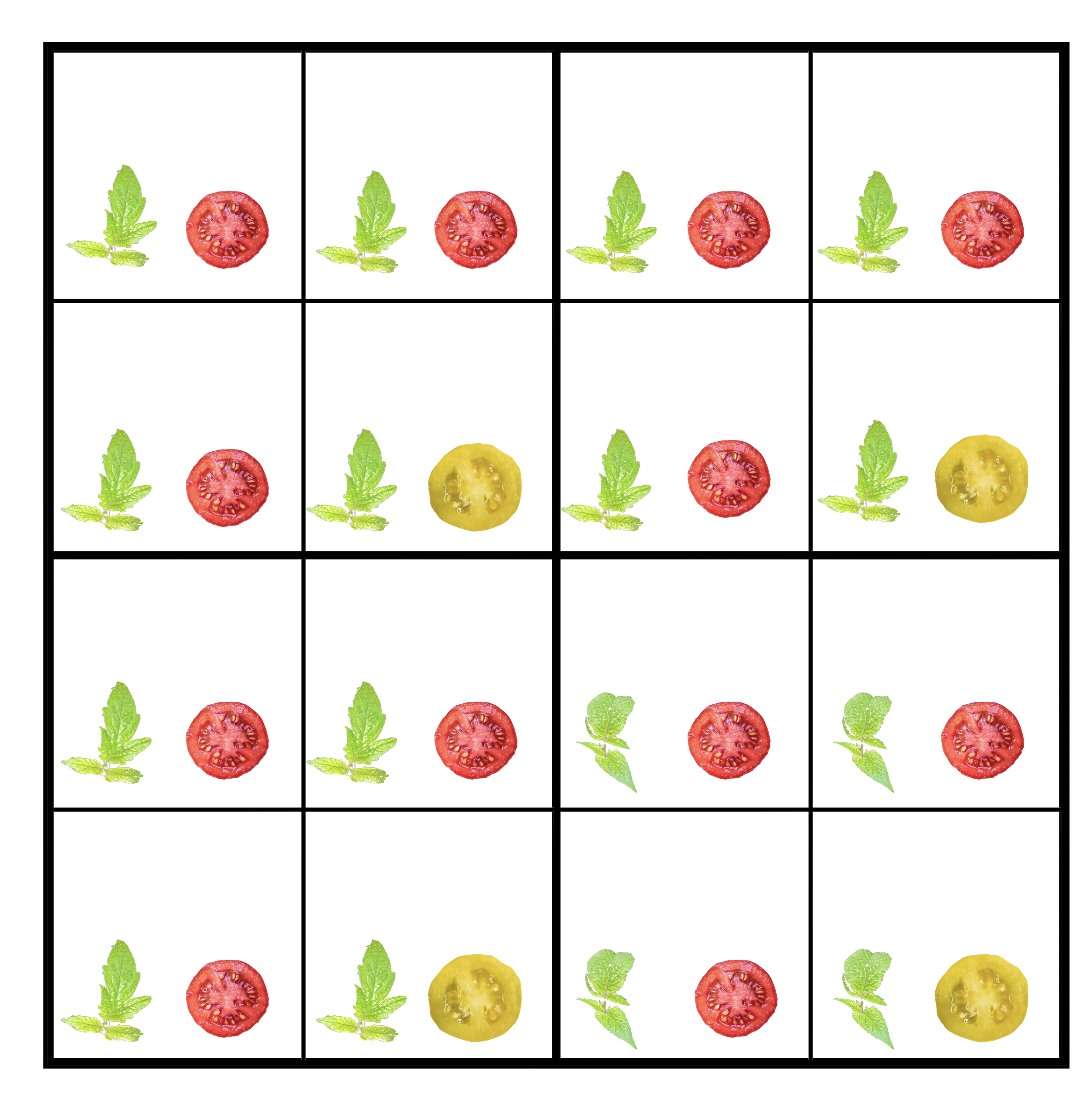
When crossing RR/cc (Red fruit regular leaf with and rr/CC (yellow fruit) potato leaf; About 1 in 4 will be yellow. About 1 in 4 will be potato leaf. About 1 in 16 will be both yellow and potato leaf. This helps demonstrate the difference between selecting for a Dominant or recessive trait. If you wanted for example a red fruit with a potato leaf, you can select at the seedling stage just the potato leaf seedlings to continue (screening out the regular leaf), and all subsequent generations will have potato leaves; it is locked in. But for the red fruit, you can weed out the yellow flower phenotypes(or yellow fruits) and save the red fruit ones, but because of the way that the Dominant trait masks the recessive one, you can't be sure that it is RR until you grow the next generation and find that out of them there are no yellow ones appearing any more (sampling/tracking).
Classical or Mendelian Genetics- Basic Ideas
Tomatoes have genes for different traits (e.g. fruit color) and different versions of these genes are called alleles (e.g ‘R’ for red, ‘r’ for yellow). These represent functional changes in the pathways of molecule production, for ‘r’ (yellow) it’s a dysfunction in the creation of an enzyme called phytoene synthase, the precursor to all carotenoids.
A basic red cherry tomato that evolved from wild relatives is the most evolutionarily simple and it’s genetic composition is like a reference point, referred to as wild-type and when a gene is different from that it is called a mutant allele. In this case ‘R’ is the wild-type allele and ‘r’ is a mutant allele.
Tomatoes have 12 chromosomes and two copies of each chromosome, so there are two alleles of each gene within the tomato DNA.
Mechanically, a Dominant allele (indicated by capital letter e.g. ‘R’) masks the effect of a recessive allele (indicated by lowercase e.g. ‘r’). In other words, one is enough for the Dominant allele to be expressed, but the recessive trait is only expressed if both alleles are the recessive ones (loss of function).
When the alleles are the same on both sets of chromosomes it is called homozygous, when they are different it is called heterozygous.
Genotypes are the genetic make up and phenotypes are the observable expression of that genotype.
The more different the skills the dancers have, the more steps are required to get them the same:
two ways of looking at it
the pair of dancers stepping around wildly and and ending up with (random skill)
the chance that at least one set of dancers will do the steps that end up with the skill slots of interest
(so the fewer steps, the slower the dance, the more likely to end up in a particular arrangement; the further apart the skills, the more likely to end up in all kinds of different places; the idea of the right amount of difference, the right amount of chaos.
Filial 1 or F1 Hybrid
When homozygous dominant RR (phenotype: red fruit) is crossed with homozygous recessive rr (phenotype: yellow fruit), the F1 will be heterozygous Rr genotype (phenotype: red fruit, ‘R’ masks ‘r’).
When that F1 pollinates itself it will form many possible “variants” or “segregants” in the F2 generation:
RR (red),
Rr (red; ‘R’ masks ‘r’) ,
rR (red; ‘R’ masks ‘r’),
rr (yellow)
One reason hybrids are desirable in some circumstances is that they exhibit ‘hybrid vigor’ or ‘heterosis,’ but when the seeds are saved there will be some that are heterozygous and some that are homozygous for each gene, unpredictable. This is not good for preserving specific outcomes, but is good for developing new combinations of traits.
Each gene is located somewhere physically on the genome, that place is called a locus, and can be referred to by the relevant allele.
The ‘R’ (or ‘r’) locus is on chromosome 3.