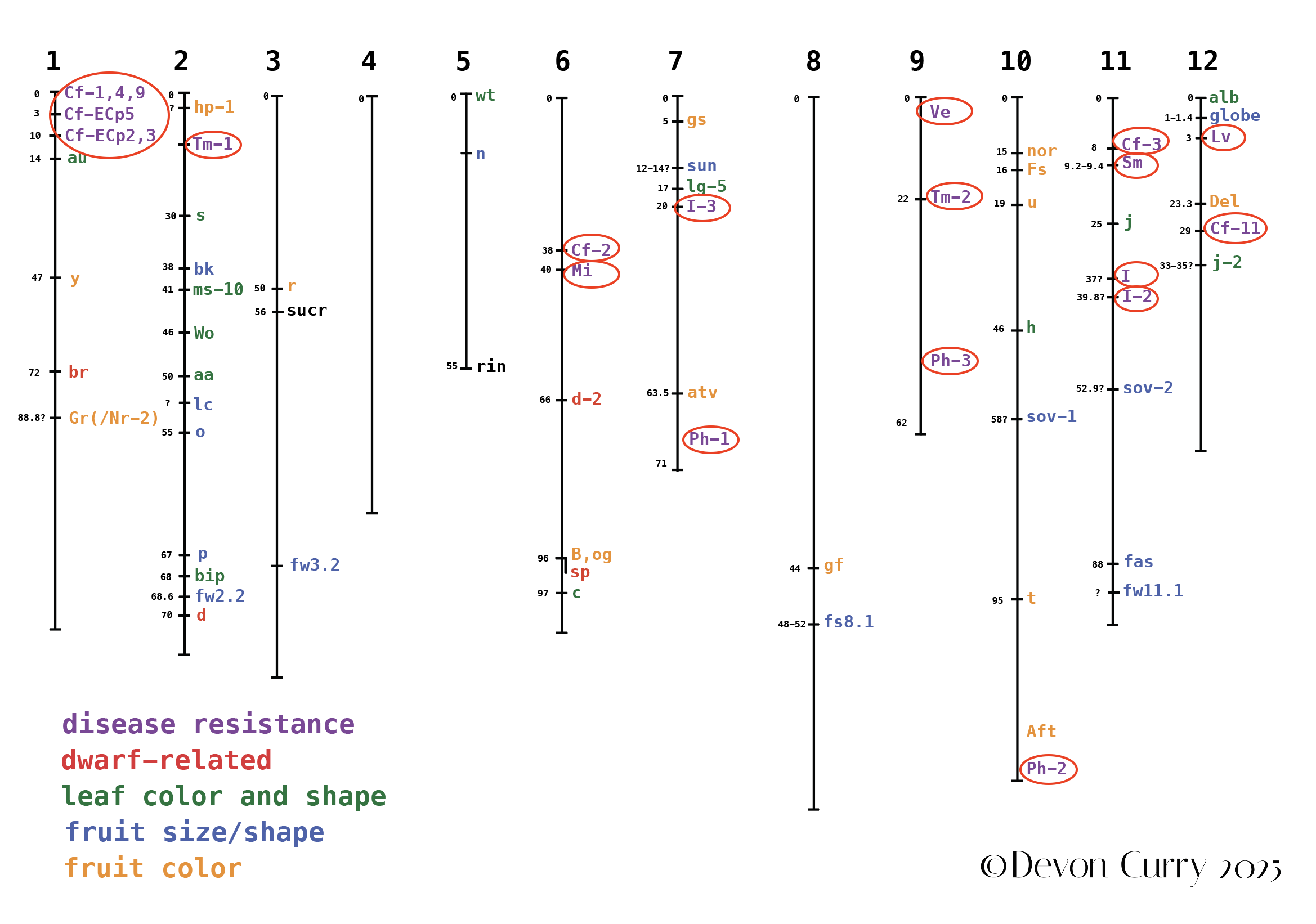
These genes influence the ability of the plant to resist the negative effects of different diseases.
Many of them are genes from wild relatives (introgressions) that were discovered and bred into tomatoes by people like Charles Rick and his colleagues at the TGRC.
They are dominant genes, that act by recognizing the pathogen and initiating an immune response, often involving a hypersensitive reaction (localized cell death) that stops the pathogen from spreading.
Cf-1 leaf mold (Cladosporium fulvum) resistance genes (from Solanum pimpinellifolium (1937).
Cf-2 (from Solanum pimpinellifolium or S. pennellii)
Cf-3 (from Solanum pimpinellifolium or S. habrochaites)
Cf-4 (from Solanum hirsutum)
Cf-ECp5 (from Solanum pimpinellifolium)
ETC
Tm-1 (Tobacco Mosaic Virus resistance) from Solanum pennellii)- interacts with ToMV replication proteins, preventing the virus from forming a replication complex with host membranes. Tm-1 combined with a specific tolerance locus on chromosome 11 is essential for effective resistance
Tm-2 (Tobacco Mosaic Virus resistance and and Tomato Mosaic Virus resistance, but not brown rugose fruit virus (ToBRFV) from Solanum peruvianum)
Tm-3 (Tobacco Mosaic Virus resistance and and Tomato Mosaic Virus resistance, but not brown rugose fruit virus (ToBRFV) from Solanum peruvianum); considered the superior resistance of the three
Currently, the industry is focusing on developing new resistance mechanisms, such as the HREZ (High Resistance) technology from Enza Zaden, to protect tomato crops from Tomato brown rugose fruit virus (ToBRFV). Derived from wild tomato species and behaves in a similar, robust manner to the industry-standard Tm-22, and is related.
Mi- nematode resistance- Meloidogyne incognita (and two other species) (from Solanum pervianum in 1940s); dominant, NBS-LRR (nucleotide-binding, leucine-rich repeat) resistance gene that confers immunity against root-knot nematodes and certain sap-sucking insects. It triggers a localized hypersensitive response (cell death) at the infection site to restrict pest feeding, but this defense fails in soil temperatures above 28C
I-3 gene (from Solanum pennellii) provides protection against race 3 of the vascular wilt pathogen Fusarium oxysporum. It encodes a S-receptor-like kinase (SRLK) that recognizes the fungus
I-2 and I-1 genes (from Solanum pimpinellifolium) provides protection against race 2 and 1.
Ph-1 gene (from Solanum pimpinellefolium) provides resistance to late blight, caused by the oomycete Phytophthora infestans. One of the first resistance genes introduced into commercial tomato cultivars. It acts through a mechanism that involves recognizing the pathogen and triggering a localized, hypersensitive cell death response to halt infection. While Ph-1 is largely ineffective on its own, it has been used in conjunction with other resistance genes, such as Ph-2 and Ph-3, to develop more robust, stacked resistance in modern breeding
Ph-2 gene (from Solanum pimpinellifolium) Recently identified as a CC-NBS-LRR disease-resistance protein that triggers a hypersensitive response (localized cell death) to combat the pathogen. Provides resistance against a wide range of P. infestans races, though it is considered partial resistance rather than immunity.
Ph-3 gene (from Solanum pimpinellifolium) Recently identified as a CC-NBS-LRR disease-resistance protein that triggers a hypersensitive response (localized cell death) to combat the pathogen. Provides resistance against a wide range of P. infestans races, considered the strongest of the three.
Ve- Verticilium wilt resistance- (caused byVerticillium dahliae and V. albo-atrum,) by encodes cell-surface glycoprotein receptors on the plasma membrane, which recognize fungal effectors and initiate an immune response; (ancient origin)
Sm- Stemphylium lycopersici gray leaf spot disease resistance (from Solanum pimpinellifolium); hypersensitivity reactions
Lv- Leveillula taurica (powdery mildew) resistance (from Solanum chilense); hypersensitive response (HR), a form of rapid programmed cell death around the infection site.
Other interesting ideas: acetyl sugars